
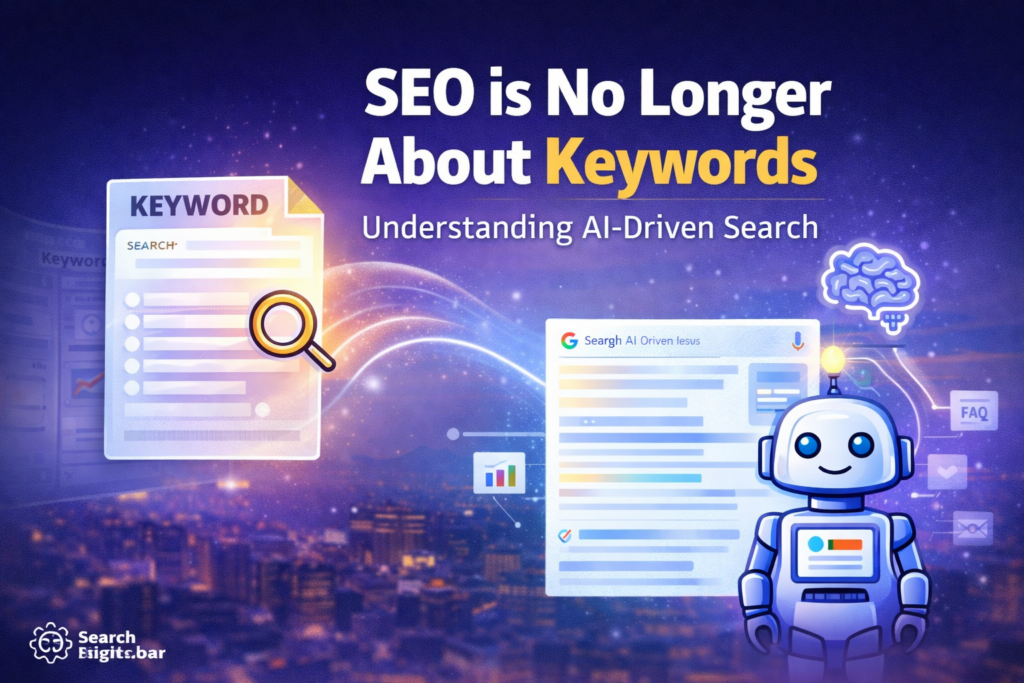
It Is About Search Intent and AI Interpretation
For years, SEO followed a predictable formula. You researched keywords, optimised pages around them, built links, and waited for rankings. That approach worked when search engines relied heavily on keyword matching.
That model is no longer enough.
Search today is driven by artificial intelligence. Google AI Overviews summarise answers directly on the search results page. ChatGPT and other generative AI tools answer questions without showing traditional rankings. Voice assistants provide spoken answers instead of links.
In this new environment, SEO is no longer about keywords alone. It is about how AI systems interpret, trust, and select your content.
SEO is not dead. It is evolving.
Why Keyword Based SEO Is Losing Effectiveness
Keyword optimisation still matters, but it is no longer the primary driver of visibility.
AI driven search has introduced several changes that reduce the impact of traditional keyword focused strategies.
Key reasons keywords alone are not enough
- AI systems interpret meaning rather than exact phrases
- Zero click searches are increasing rapidly
- Users ask longer, conversational questions
- Search engines summarise answers instead of ranking pages only
A page can rank well but still be ignored by AI systems if it lacks clarity, structure, or authority.
At the same time, a page that does not rank first can still gain massive exposure if it is selected as a source for AI generated answers.
The Shift From Keywords to Search Intent
Search intent is now the foundation of modern SEO.
Every search represents a goal or problem. AI systems are designed to identify that intent and deliver the most helpful response.
The four main types of search intent
Informational intent
Users want to learn or understand something.
Examples include:
- What is AI search optimisation
- How does Google AI Overviews work
Navigational intent
Users want to find a specific brand or platform.
Examples include:
- Connect2 leased line pricing
- Merit Content SEO services
Commercial intent
Users are comparing options before making a decision.
Examples include:
- Best leased line providers in the UK
- SEO agencies specialising in AI search
Transactional intent
Users are ready to take action.
Examples include:
- Buy leased line
- Book SEO consultation
AI systems prioritise content that clearly matches intent. If your content does not align with what the user is actually trying to achieve, it will not be selected.
How AI Systems Evaluate Content Quality
AI driven search engines use a combination of signals to decide which content to surface.
1. Clear structure
AI needs to understand content quickly.
Content performs better when it includes:
- Clear H1 and H2 headings
- Short paragraphs
- Bullet points and numbered lists
- Direct answers near the top of the page
Pages that hide answers or rely on vague introductions struggle to gain AI visibility.
2. Real expertise and authority
AI systems favour content that demonstrates genuine expertise.
This includes:
- First hand experience
- Practical examples
- Clear explanations written by identifiable experts
- Consistent topical authority across a website
Generic content that repeats existing information without adding insight is filtered out.
3. Helpfulness and completeness
AI prefers content that fully satisfies the query.
High performing content:
- Answers the main question clearly
- Addresses common follow up questions
- Covers the topic comprehensively rather than superficially
This is why topic based content and long form guides outperform thin keyword pages.
Google AI Overviews and Modern SEO
Google AI Overviews represent one of the biggest changes in search behaviour.
Instead of showing only ranked pages, Google now:
- Analyses multiple sources
- Extracts key insights
- Presents a summarised answer directly in search results
To appear in Google AI Overviews, content must:
- Answer the query clearly and accurately
- Be easy to extract and summarise
- Come from a trusted and authoritative source
- Be structured logically
Schema markup and clear formatting significantly improve eligibility.
ChatGPT and Generative Search Visibility
ChatGPT and similar tools do not rank content in the traditional sense.
They select information based on:
- Relevance to the question
- Clarity of explanation
- Authority and trustworthiness
- Ease of reuse in conversational answers
To optimise for ChatGPT style answers
- Write in a clear, conversational tone
- Avoid unnecessary jargon
- Structure content around questions and answers
- Provide complete explanations without filler
Visibility in generative search often leads to increased brand trust and inbound leads, even without direct links.
Voice Search and Conversational Queries
Voice search continues to grow across mobile devices, smart speakers, and vehicles.
Voice queries differ from typed searches in important ways.
Voice search characteristics
- Longer and more natural phrasing
- Question based language
- Expectation of a single clear answer
How to optimise for voice search
- Use natural language
- Include question and answer sections
- Write concise responses
- Ensure content sounds natural when read aloud
Voice assistants usually select one answer, which makes clarity and structure essential.
Schema Markup Examples for AI Search and Google AI Overviews
Schema markup helps AI systems understand the purpose and structure of your content.
FAQ schema example
Highly effective for AI Overviews, ChatGPT extraction, and voice search.
{
“@context”: “https://schema.org”,
“@type”: “FAQPage”,
“mainEntity”: [
{
“@type”: “Question”,
“name”: “Is SEO still relevant in the age of AI search?”,
“acceptedAnswer”: {
“@type”: “Answer”,
“text”: “Yes. SEO is still relevant, but it has evolved. Modern SEO focuses on search intent, content structure, and expertise so that AI systems can interpret and reuse content accurately.”
}
},
{
“@type”: “Question”,
“name”: “What is AI search optimisation?”,
“acceptedAnswer”: {
“@type”: “Answer”,
“text”: “AI search optimisation focuses on creating content that is easy for AI systems like Google AI Overviews, ChatGPT, and voice assistants to understand and trust.”
}
}
]
}
Article and author schema example
Supports authority and trust signals.
{
“@context”: “https://schema.org”,
“@type”: “Article”,
“headline”: “SEO Is No Longer About Keywords, It Is About Search Intent and AI Interpretation”,
“author”: {
“@type”: “Person”,
“name”: “Joseph”,
“jobTitle”: “SEO Specialist and AI Search Optimisation Consultant”,
“url”: “https://www.meritcontent.com/”
},
“publisher”: {
“@type”: “Organization”,
“name”: “Merit Content”
}
}
HowTo schema example
Ideal for guides and instructional content.
{
“@context”: “https://schema.org”,
“@type”: “HowTo”,
“name”: “How to Optimise Content for AI Search”,
“step”: [
{
“@type”: “HowToStep”,
“name”: “Identify search intent”,
“text”: “Understand the problem the user is trying to solve.”
},
{
“@type”: “HowToStep”,
“name”: “Structure content clearly”,
“text”: “Use headings, short paragraphs, and lists.”
},
{
“@type”: “HowToStep”,
“name”: “Demonstrate expertise”,
“text”: “Include real insights and practical examples.”
}
]
}
Case Study One:
Connect2 and AI Ready SEO in the UK Connectivity Market
Connect2 operates in a competitive UK connectivity space focused on leased lines and FTTP.
Initial challenge
- Keyword heavy pages
- Limited AI visibility
- Strong rankings but low AI exposure
Strategy changes
- Rebuilt pages around buyer intent
- Added clear pricing explanations
- Introduced structured FAQs
- Implemented schema markup
- Included expert commentary
Results
- Increased visibility in Google AI Overviews
- Improved lead quality
- Stronger trust signals for commercial queries
This showed that AI visibility can drive results even without ranking changes.
Case Study Two:
Blog Content Optimised for ChatGPT Visibility
Problems identified
- Generic content
- Weak structure
- No clear answers
Optimisation steps
- Answered core questions early
- Rewrote sections as Q and A
- Highlighted author expertise
- Improved conversational tone
Outcome
- Brand appeared in ChatGPT generated answers
- Increased inbound trust and awareness
- Higher quality enquiries
Case Study Three:
Voice Search Optimisation for Local Pages
Key improvements
- Question focused content
- Short and spoken style answers
- Local business and FAQ schema
- Simplified language
Results
- Improved voice search selection
- Increased mobile engagement
- More calls from informed users
The Future of SEO Is Intent-Focused and AI-Friendly
SEO is becoming more strategic, not less relevant.
Winning visibility now requires:
- Intent driven content
- Clear structure
- Demonstrated expertise
- AI friendly formatting
The goal is no longer just to rank. The goal is to be selected.
AI Ready SEO Checklist
Search intent and content
- Main question answered early
- Intent clearly matched
- Follow up questions covered
Structure and readability
- Clear H1 and H2 hierarchy
- Short paragraphs
- Bullet points and lists
- FAQ section included
Expertise and trust
- Author credentials visible
- Real examples included
- No generic filler content
AI optimisation
- Schema markup implemented
- Conversational language used
- Content suitable for voice search
Authority and maintenance
- Content updated regularly
- Strong internal linking
- Topic covered comprehensively
Final Thoughts
SEO is not dying. It is evolving into something more intelligent and more valuable.
Businesses that adapt to AI driven search will gain visibility where competitors disappear.
Those who focus on intent, clarity, and expertise will not just survive the future of search. They will lead it.

Joseph is an SEO Specialist and the founder of Search Engine Star, a results-driven SEO agency dedicated to helping businesses boost visibility, rank higher, and grow through smart search strategies. With years of experience in eCommerce SEO, AI-driven optimization, and SEO copywriting, Joseph has helped brands increase organic traffic and secure top spots in Google’s AI Overviews and featured snippets.