
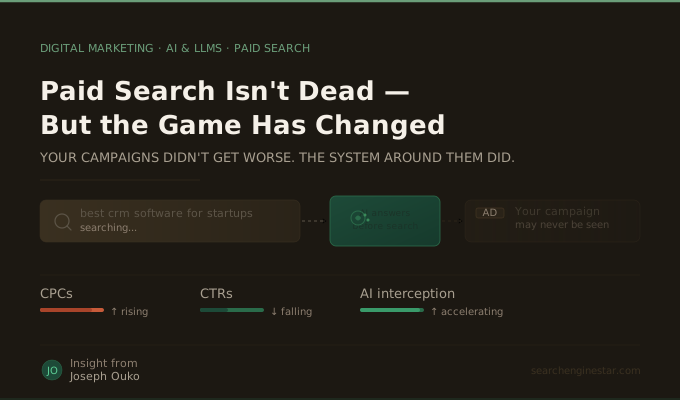
Your campaigns didn’t suddenly get worse. The system around them did.
If you’ve been staring at your paid search dashboards lately and wondering why the numbers feel off — you’re not imagining it. CPCs are climbing. CTRs are slipping. And most marketing teams are responding the only way they know how: optimize harder, test more, push the budget further.
But here’s the uncomfortable truth: the problem isn’t your campaigns. It’s that the users those campaigns are chasing have fundamentally changed how they behave online.
They’re not searching anymore. They’re asking.
The behavior shift nobody saw coming
For two decades, the search funnel was predictable. Someone had a question, they typed it into Google, they saw ads, they clicked. Marketers built entire empires on that loop.
Then large language models arrived — and quietly began intercepting that loop at the very first step.
The old funnel vs. the new one
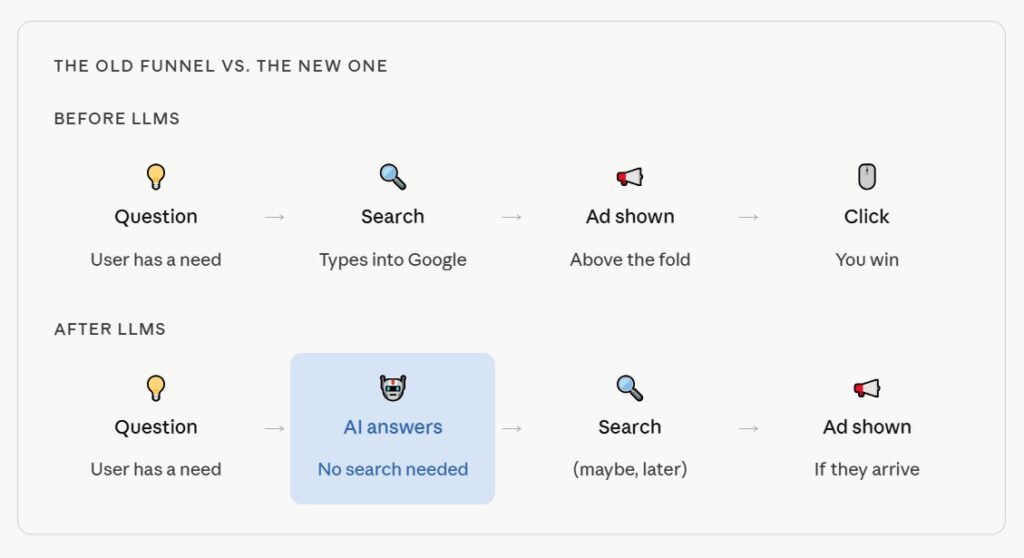
AI tools like ChatGPT, Perplexity, and Google’s own AI Overviews are now answering questions before users ever reach a search results page — let alone an ad. The awareness stage of the customer journey has been silently hijacked, and most marketing teams haven’t updated their playbooks to account for it.
“You’re not just competing for clicks anymore. You’re competing to be included in the decision.”
Why optimizing harder won’t fix a structural shift
When metrics decline, the instinct is to dig into the account. Tighten match types. Refresh ad copy. Rethink bidding strategy. And in many cases, that instinct is right — there’s always room to improve execution.
But when the decline is structural — when it stems from fewer people entering the funnel in the first place — no amount of optimization will reverse it. You can have the most perfectly tuned campaign in history, and it still won’t reach users who resolved their query with an AI chatbot before they ever opened a browser tab.
The problem
↑ CPCs
Cost-per-click rising across most verticals
The symptom
↓ CTRs
Fewer users clicking even when ads appear
The root cause
AI first
Questions answered before search ever begins
This is the distinction that matters: unpredictability in your paid search performance isn’t a sign that your strategy is broken. It’s a sign that the environment has changed around a strategy that was built for a different era.
Where paid search still delivers real value
None of this means paid search is dying. Far from it. For many brands, it remains the single fastest lever for capturing demand — especially when that demand already exists and users are actively looking to act on it.
Paid search still shines in a few specific scenarios:
Newer brands without organic visibility. If you haven’t built up a content library or SEO authority yet, paid search is still the most direct path to getting in front of buyers. AI hasn’t eliminated the need for brand discovery — it’s just moved the goalposts on where that discovery happens.
High-intent, bottom-of-funnel queries. When someone searches “buy [product] near me” or “[brand] pricing,” they’ve already done their research. They’re not asking an AI for a recommendation — they’re ready to transact. This is where paid search continues to perform at its best.
Capturing existing demand, not generating it. The role of paid search is shifting from demand generation to demand capture. If you can make peace with that narrower mandate, you’ll invest more efficiently and measure more honestly.
How to adapt without rebuilding everything
The good news: you don’t need to tear down your paid search infrastructure and start over. You need to reposition it — and build alongside it.
01
Reframe what paid search is for
Stop expecting it to do the entire job. It’s a demand-capture channel now — treat it like one.
02
Invest in LLM visibility
Create content that AI models surface as answers. Being cited in ChatGPT is the new first-page ranking.
03
Double down on intent signals
Focus budget on queries where users are already committed — not just curious.
04
Audit your upper funnel
If AI is intercepting awareness, where are you building it instead? That gap needs a strategy.
The brands that will win in this environment are those that understand the new customer journey holistically — not just the paid slice of it. That means thinking seriously about where your brand shows up when someone asks an AI for a recommendation, and whether the content that trains those models reflects well on you.
The bottom line
Paid search isn’t broken. It’s been repositioned by a shift in user behavior that nobody voted for and nobody could fully anticipate. The teams that adapt will treat it as a precise, high-intent tool within a broader strategy. The teams that don’t will keep optimizing their way around a problem that optimization alone can’t solve.
The old game was: win the click. The new game is: be part of the decision before the click ever happens.
Adjust accordingly.

Joseph is an SEO Specialist and the founder of Search Engine Star, a results-driven SEO agency dedicated to helping businesses boost visibility, rank higher, and grow through smart search strategies. With years of experience in eCommerce SEO, AI-driven optimization, and SEO copywriting, Joseph has helped brands increase organic traffic and secure top spots in Google’s AI Overviews and featured snippets.