
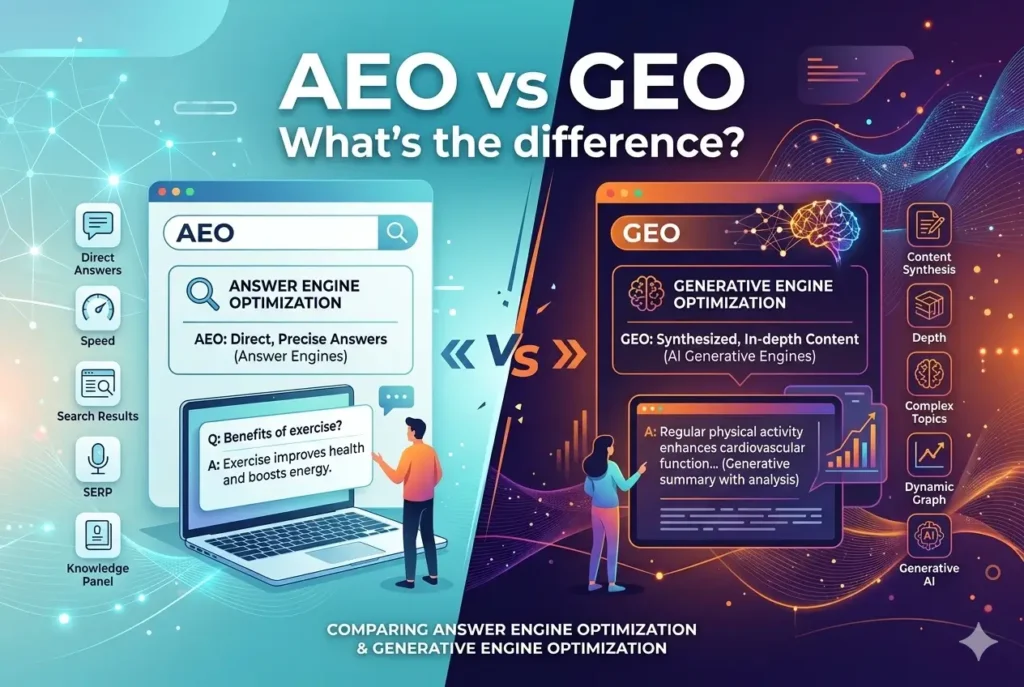
If you’ve been paying attention to the world of digital marketing lately, you’ve probably started hearing two acronyms thrown around a lot: AEO and GEO. They sound similar, they’re often mentioned in the same breath, and they’re both part of the rapidly evolving landscape of AI-powered search.
But they are not the same thing — and understanding the distinction could be one of the most important moves you make for your brand’s visibility in 2024 and beyond.
In this post, I’m going to break down exactly what AEO and GEO mean, how they differ, how they overlap, and most importantly — what you should be doing about both.
First, Let’s Set the Scene: The Rise of AI Search
Not long ago, search engine optimisation (SEO) was the dominant strategy for getting found online. The goal was simple: rank on Google’s first page, get clicks, drive traffic.
But the way people search is changing fast. Instead of typing keywords into Google and scrolling through blue links, more and more people are asking AI tools — like ChatGPT, Perplexity, Google’s AI Overviews, and Microsoft Copilot — direct questions and expecting direct answers.
These tools don’t give you ten links to browse. They give you one answer. Sometimes with a citation. Sometimes without.
This shift is massive. And it means that if your brand isn’t showing up in those AI-generated answers, you’re invisible to a growing segment of your audience — no matter how well your website ranks on traditional search.
This is the world in which both AEO and GEO were born.
What is AEO? (Answer Engine Optimisation)
AEO stands for Answer Engine Optimisation. It is the practice of structuring and formatting your content so that AI-powered answer engines — like Perplexity, ChatGPT, Google’s AI Overviews, and similar tools — surface your brand, content, or expertise as the direct answer to a user’s question.
Think of it like this: traditional SEO gets you onto the shelf in the library. AEO makes you the book the librarian hands someone when they walk in and ask a question.
The Core Goal of AEO
The goal of AEO is to be cited as the answer — not just a source. When someone asks an AI tool a question relevant to your brand or industry, AEO is what ensures your content, your name, or your business is what the AI delivers back.
How Does AEO Work in Practice?
AEO focuses on a few key tactics:
- Structured Q&A content — Writing content that directly and clearly answers specific questions, mirroring how users phrase queries to AI tools.
- FAQ pages and schema markup — Using structured data (like FAQ schema) so AI systems can easily extract and present your answers.
- Concise, authoritative responses — AI tools favour content that answers questions clearly and completely, without fluff.
- Featured snippet optimisation — Content that already ranks as a featured snippet on Google is more likely to be used by AI Overviews and similar tools.
- Entity clarity — Ensuring your brand, products, and services are clearly defined and consistently described across the web, so AI can identify and cite you accurately.
Example: If someone types ‘What is the best CRM for small businesses?’ into Perplexity and your brand appears as the recommended answer, that is AEO working.
What is GEO? (Generative Engine Optimisation)
GEO stands for Generative Engine Optimisation. It is a broader strategy focused on shaping how AI models perceive, describe, and recommend your brand across all generative AI platforms — not just in response to a single question, but as part of how the AI ‘understands’ your brand in general.
If AEO is about getting the right answer in a specific moment, GEO is about building the kind of brand presence and authority that makes AI tools consistently portray you positively and accurately — across every context, conversation, and platform.
The Core Goal of GEO
GEO is about controlling your brand’s narrative in the AI era. Large language models like GPT-4, Gemini, and Claude are trained on vast amounts of web content. What they say about your brand is heavily influenced by what exists about you across the internet — blog posts, reviews, news articles, citations, social media, and more.
GEO is the discipline of actively shaping that body of content so that AI models learn the right things about you — and say the right things when asked.
How Does GEO Work in Practice?
GEO involves a wider set of strategies:
- Brand narrative consistency — Ensuring your messaging, positioning, and descriptions are consistent everywhere your brand appears online.
- Building high-quality citations and backlinks — Getting credible, authoritative sources to mention and link to you, as these are the ‘training signals’ AI models pick up on.
- Thought leadership content — Publishing expert insights, original research, and in-depth guides that establish your brand as an authority in your field.
- AI visibility monitoring — Tracking what AI tools say about your brand when asked and identifying gaps or inaccuracies to correct.
- Managing your digital footprint — Proactively creating positive, accurate content across multiple platforms so AI models have quality signals to draw from.
- Wikipedia and knowledge graph presence — Ensuring your brand is accurately represented in sources that AI models heavily reference.
Example: If someone asks ChatGPT ‘What are the leading digital marketing agencies in Nairobi?’ and your agency consistently comes up as one of the top recommendations — that is GEO working.
AEO vs GEO: Side-by-Side Comparison
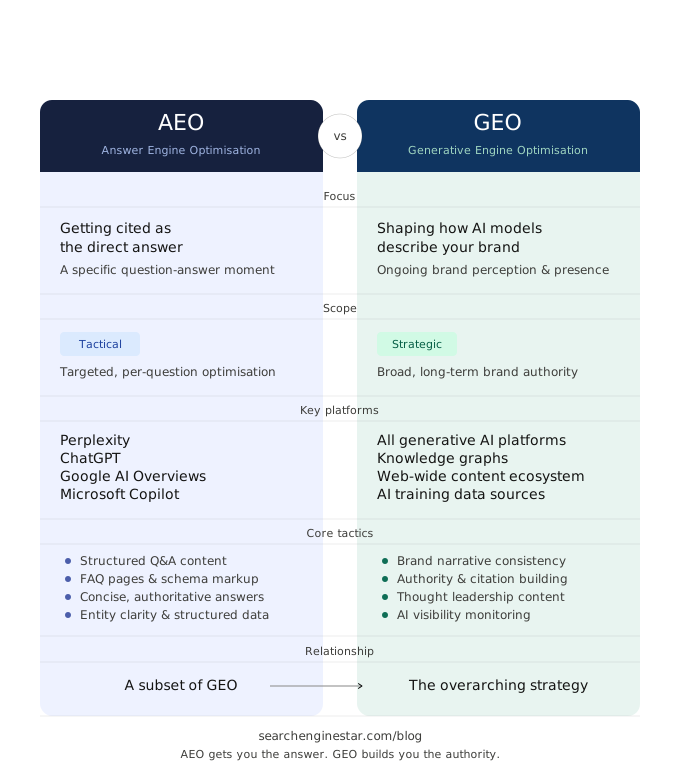
| AEO | GEO | |
| Full Name | Answer Engine Optimisation | Generative Engine Optimisation |
| Primary Goal | Get cited as a direct answer | Shape how AI describes your brand |
| Scope | Narrower — question-answer focus | Broader — brand perception & presence |
| Key Platforms | Perplexity, ChatGPT, AI Overviews | All AI models & generative platforms |
| Tactics | Structured Q&A content, FAQs, schema | Brand narrative, citations, authority building |
| Relationship | A subset of GEO | The overarching strategy |
So What’s the Real Difference?
Here’s the simplest way I explain it to clients and founders:
AEO: Optimising for a specific moment — making sure your content is the answer when a user asks a relevant question.
GEO: Optimising for an ongoing relationship — making sure AI models consistently understand, trust, and recommend your brand.
AEO is tactical. GEO is strategic.
AEO asks: ‘How do I get cited right now, for this question?’
GEO asks: ‘How do I ensure AI models always represent my brand accurately and favourably?’
AEO is a subset of GEO. If you’re doing GEO well, AEO often follows naturally — because a brand with strong authority, clear messaging, and well-structured content will naturally be cited as an answer to relevant questions.
But you can do AEO without a full GEO strategy — for example, by optimising a specific FAQ page to appear in AI Overviews. It just won’t give you the deeper, more durable brand visibility that GEO provides.
Why Both Matter for Your Brand
Here’s why this isn’t just marketing jargon — it’s a real shift that affects your bottom line.
1. AI Search is Growing Fast
Perplexity alone has gone from near-zero to tens of millions of monthly active users in just two years. ChatGPT, Gemini, and AI Overviews are now part of how a significant — and rapidly growing — portion of your potential customers find information and make decisions.
2. Traditional SEO is No Longer Enough
Ranking on Google is still important, but it no longer guarantees visibility. If your brand doesn’t appear in AI-generated responses, you’re missing a critical and growing channel. Some studies suggest that AI Overviews appear for over 50% of informational queries on Google.
3. First-Mover Advantage is Real
GEO and AEO are still relatively new disciplines. Brands that invest in them now will build an AI presence that becomes harder to displace over time — just as early SEO adopters dominated search rankings for years. This is the moment to move.
4. Trust is Built at the Answer Level
When an AI tool recommends your brand as the answer to a user’s question, it carries enormous implicit trust. The user didn’t choose you from a list — the AI chose you for them. That level of credibility is increasingly difficult to achieve through traditional advertising.
Where to Start: A Beginner’s Roadmap
If you’re just getting into AEO and GEO, here’s a practical sequence to follow:
- Audit what AI says about you now — Ask ChatGPT, Perplexity, and Gemini questions about your industry and your brand. What comes up? What’s missing or inaccurate?
- Clarify your brand narrative — Define how you want to be described. What do you do? Who do you serve? What makes you different? Make this consistent everywhere.
- Create structured answer content — Write blog posts and FAQs that directly answer the questions your target audience is asking AI tools.
- Build authority signals — Get mentioned in credible publications, earn quality backlinks, and establish thought leadership in your niche.
- Monitor and refine — AI visibility is dynamic. Track how AI tools represent you over time and keep improving.
Final Thoughts
AEO and GEO are not buzzwords. They are the next frontier of brand visibility — and the brands that understand the distinction and act on it early will have a significant advantage in the years ahead.
To summarise: AEO gets you the answer. GEO builds you the authority. You need both.
I’ll be writing much more about each of these topics — including specific tactics, tools, and case studies — right here on this blog. If you found this useful, follow me on LinkedIn where I post regularly about AEO, GEO, and the future of AI search.
Want to learn more?
Visit Search Engine Star’s blog for more beginner-friendly guides on AEO, GEO, and AI-powered brand visibility.

Joseph is an SEO Specialist and the founder of Search Engine Star, a results-driven SEO agency dedicated to helping businesses boost visibility, rank higher, and grow through smart search strategies. With years of experience in eCommerce SEO, AI-driven optimization, and SEO copywriting, Joseph has helped brands increase organic traffic and secure top spots in Google’s AI Overviews and featured snippets.